
Shark Bite Force: How Powerful Is a Shark’s Bite?
One of the most amazing things about sharks is their bite force. Sharks have dominated the world’s oceans for more than 400 million years and evolved into some of the most efficient predators on Earth. Movies usually show sharks as unstoppable killers with jaws that crush, but the truth is much more interesting and much more scientific. A shark bite is not just about raw strength. Different species have developed distinct jaw structures, tooth shapes, and hunting strategies perfectly suited to their prey. Some rely on immense pressure to crush shells, while others use sharp teeth to cut flesh. Often, bite force is just one part of a highly specialised hunting system.

What Is Shark Bite Force?
The total mechanical force generated by a shark’s jaw muscles when it closes its jaws is referred to as “shark bite force. Scientists use Newtons (N) to measure this actual force, which allows them to analyse jaw and muscle function independently and compare species. In contrast, popular media often discusses shark bites in Pounds per Square Inch (PSI); however, PSI measures the concentrated pressure exerted by the teeth, rather than the raw muscle force. Several variables influence an individual shark’s bite force, including body size, jaw muscle mass, skull structure, jaw mechanics, and feeding behaviour.
How Do Scientists Measure Shark Bite Force?
Because measuring live sharks poses major safety risks, scientists rely on a mix of direct and indirect methods:
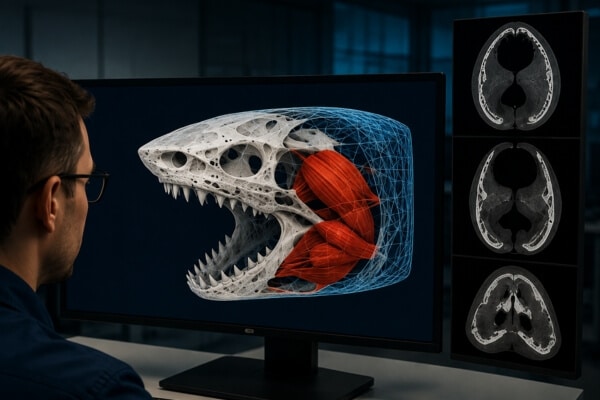
- Computer Simulation: The most recent research creates complex 3-D computer simulations of the skulls of various shark types using computer tomography (CT) scans. These models simulate muscle contraction to approximate the maximum force applied during biting.
- Bite Force Sensors: Some researchers have used mechanical sensors to measure the actual bite force of sharks as they bite onto equipment designed specifically to protect the sensors.
- Anatomical Data Collection: In addition to these approaches, scientists collect data on the size, location, and arrangement of a shark’s teeth; the anatomy of its jaw muscles; the overall shape of its skull and the mechanical leverage of the jaw system.
Which Shark Has the Strongest Bite Force?
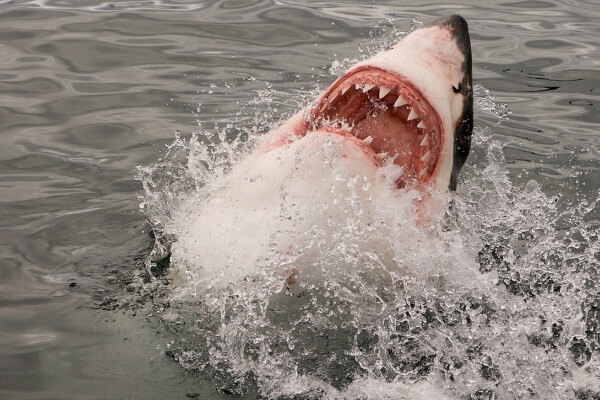
Great White Shark.
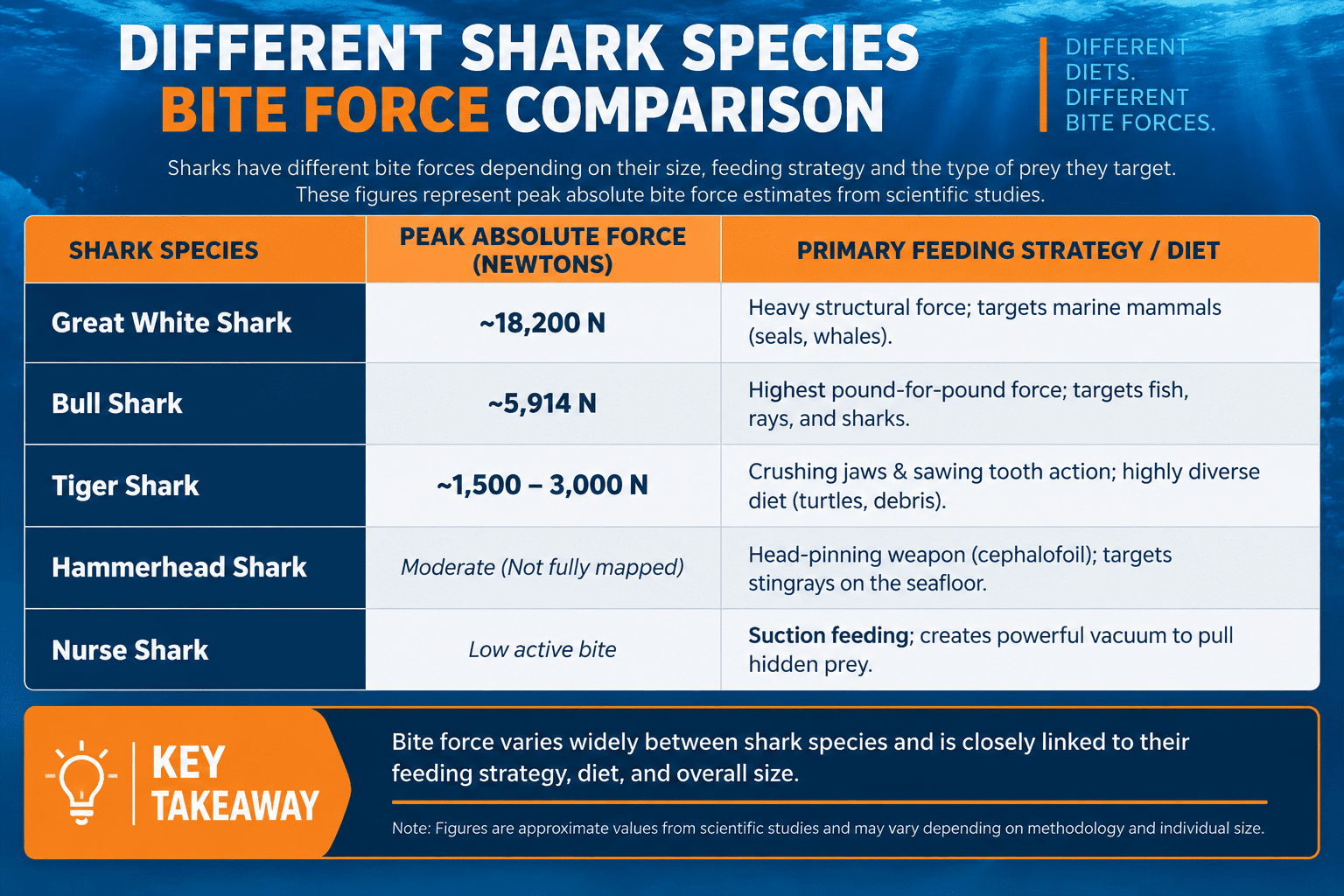
As the largest macropredatory shark in the world, in terms of weight, the Great White Shark (Carcharodon carcharias) has the highest estimated bite force among all currently existing shark species. A biomechanical model for estimating the biting forces generated by sharks shows that an adult 6-meter-long great white shark can produce around 18,200 newtons or 4,100 lbf. Larger-than-average specimens of this shark species, weighing more than 2.5 tons, likely produce even greater forces. Compared with other smaller shark species with larger pound-for-pound ratios, such as the Bull Shark, the mechanical advantage conferred by its body size makes the great white the best predator in its category. These massive forces allow great white sharks to prey on large animals, including seals and sea lions, large schools of fish, dolphins, and dead whales. Their massive jaws work together with large, triangular, serrated teeth that cut through layers of skin, muscle, and blubber.
How Does Shark Bite Force Compare Between Species?
What Makes Shark Bite Force So Powerful?
Sharks’ Extremely Powerful Jaw Muscles And Their Anatomical Structure: The exceptional strength of sharks’ jaw muscles can be attributed to the highly developed nature of their heavily reinforced cartilaginous skulls (chondrocrania) as well as the significant structural support provided by those extremely robust cartilages. Together, this anatomically superior combination provides both enormous closing force and speed when attacking prey. In contrast to the vast majority of mammalian species, nearly all shark species exhibit hyostylic suspension of their lower jaws, meaning these jaws are supported by flexible connective tissue as well as mobile cartilage elements. These two unique anatomical features allow many shark species to protrude their jaws outward, increasing the distance their bites can extend, increasing their maximum gape size, and enhancing their ability to grasp prey firmly.
Specialised Dentition: Although the powerful musculature of a shark’s jaws would be ineffectual in capturing and killing its prey without similarly specialised dentition, there has been a wide variety of adaptations of tooth morphology among the various species of sharks; each adaptation being tailored to meet the needs of the species’ specific diet:
Great White Sharks: Large, triangular-shaped teeth with prominent serrations, which are used primarily for shearing and cutting through the thick layers of fat and muscle found within large marine mammals.
Tiger Sharks: Curved, heavy-serrated “cockscomb” type teeth, similar to saws, which enable the tiger shark to efficiently cut through even the toughest flesh and break open very hard sea turtle shells.
Mako Sharks: Narrow, sharp-dagger type gripping teeth, specifically used to pierce into and hold onto very fast and slippery fish such as tuna and swordfish.
Whale Sharks: Thousands of very small vestigial teeth that do not serve any functional purpose in feeding. Instead, whale sharks use a sophisticated series of mesh-like gill rakers to capture and filter small organisms and plankton from the water column.
Is Shark Bite Force Stronger Than Other Animals?
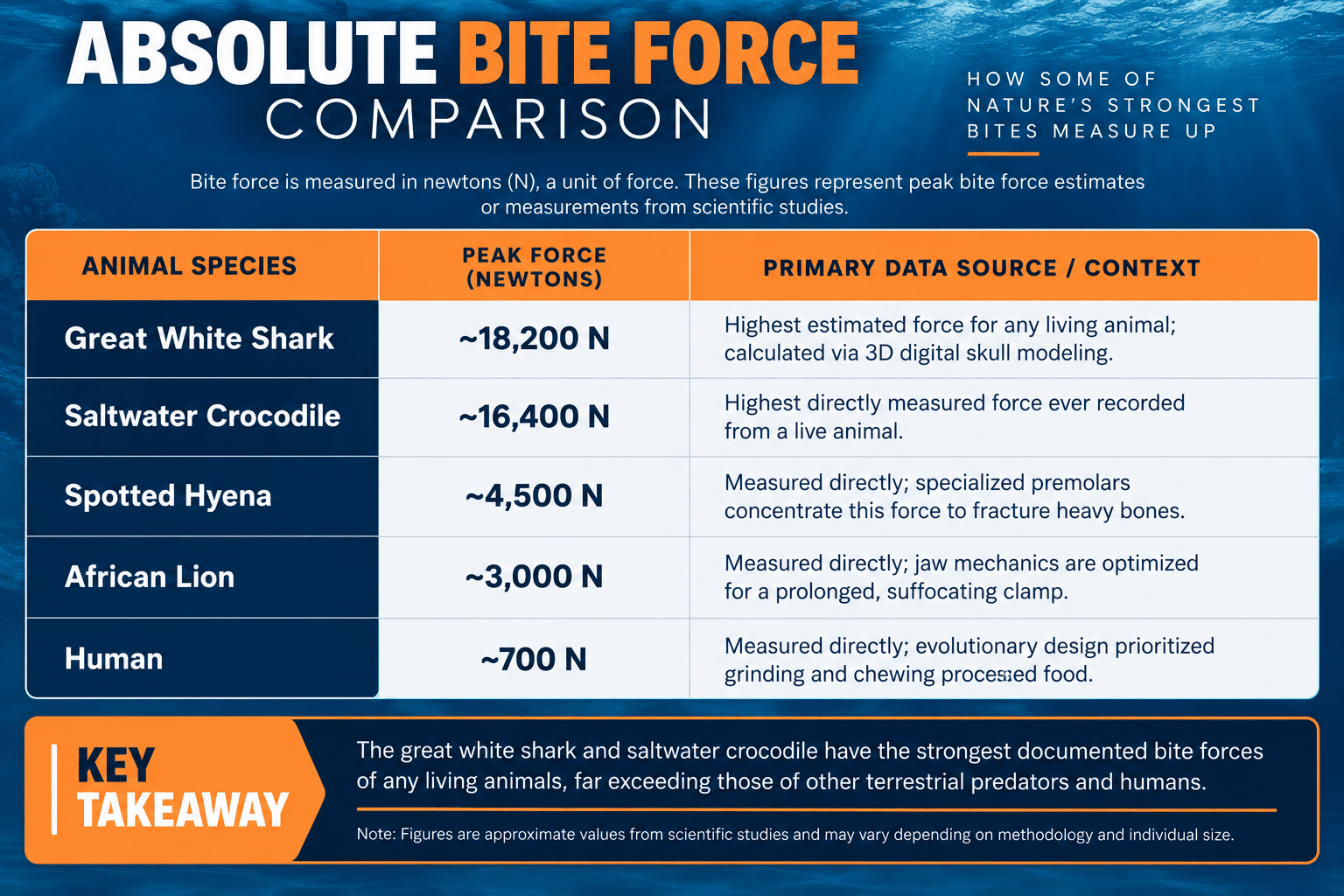
While some shark species produce immense crushing power, they do not hold a monopoly on jaw strength. Several land and semi-aquatic vertebrates generate comparable—or even superior—levels of absolute mechanical force.
Does Every Shark Need a Powerful Bite?
Absolutely not. More than 500 types of sharks have evolved to use different feeding methods. Many do not crush anything.
Whale Shark: This shark is known as the largest shark (and fish) in the world. Whale Sharks are gentle filter-feeding creatures; they can grow up to 18 meters long and eat mostly plankton, little fish and krill. As such, the force at which they bite has virtually no impact on what they eat.
Basking Shark: Basking sharks (second-largest fish) are also filter-feeding animals, but even larger and slower-swimming than whales. They do not hunt for food by chasing or catching it. Instead, they swim through the water with their mouths open and trap a tremendous amount of microscopic zooplankton using highly specialised gill-structure modifications.

Shark Bite Force vs. Tooth Design
Raw bite force is only half of the equation; a shark’s hunting success depends entirely on how that force is applied. Evolution has shaped shark teeth into four basic functional designs, each perfectly tailored to a specific diet:
- Serrated Slicing Teeth (The Saws): Built to shear large pieces of flesh from heavy prey.
- Great White Sharks: Utilize large, triangular, serrated upper teeth that act like meat saws to cut through thick mammal blubber.
- Tiger Sharks: Possess curved, heavily serrated teeth resembling a can opener. Combined with a sideways head shake, they saw through bone and hard sea turtle shells.
- Grasping Needle Teeth (The Daggers): Engineered for speed and precision rather than crushing power.
- Mako & Sand Tiger Sharks: Feature long, thin, razor-sharp, smooth teeth. These act like daggers to instantly pierce and lock down slippery, fast-moving prey like tuna, mackerel, and squid.
- Dense Crushing Teeth (The Grinders): Designed to withstand massive pressure without breaking.
- Horn Sharks: Inhabit the seafloor and possess flat, tile-like teeth arranged like a cobblestone street. These plates allow them to easily crush the armor of crabs, clams, and sea urchins.
- Vestigial Teeth (The Non-Functional): Teeth that have completely lost their original evolutionary purpose.
- Whale Sharks: Possess thousands of tiny, microscopic teeth that play zero role in feeding. Instead, they actively gulp water and use internal, mesh-like gill rakers to strain plankton and small organisms from the water column.
Why Don’t Sharks Break Their Teeth?
One remarkable adaptation of sharks is the continuous replacement of teeth. Unlike humans who get only two sets of teeth in a lifetime, sharks replace worn or damaged teeth constantly. Most species have multiple rows of developing teeth hidden behind the active front row. This system works kind of like a conveyor belt: As a front tooth breaks or dulls during hunting, a new, fully formed tooth rotates forward to replace the old one. Replacement time varies by species; teeth are typically replaced every few weeks. Over a lifetime, an individual shark can go through tens of thousands of teeth. Having a constant supply of teeth keeps their bite sharp and highly effective throughout their lives.
Does Shark Bite Force Make Sharks Dangerous to Humans?
Although sharks have an incredible bite force, they attack humans very rarely.
Humans are not natural prey for sharks. The most common reasons that lead to attacks by sharks include;
– Misidentification
– Sharks may be curious
– A shark will act in self-defence when it feels threatened or cornered. Once a shark identifies the person being bitten as not its natural prey, it usually lets go and leaves immediately. Millions of people safely use the oceans each year. Understanding how sharks behave is much more beneficial than fearing what their bite can accomplish.
Does Shark Bite Force Make Sharks Dangerous to Humans?
The Great White Sharks’ ability to generate such powerful bites through evolutionary engineering is likely among the most impressive feats of engineering.
Combined with specialised teeth, flexibility in their jaws and millions of years of adaptation, sharks are incredibly well-suited to their environments. The strength of the bite is just one element that makes these ancient predators remarkable. Studying the biological characteristics of sharks can help replace fear with appreciation and emphasise the importance of protecting them to maintain healthy ocean ecosystems.
We are always learning more about how sharks use their powerful jaws by studying shark bite force and the biological mechanisms that allow them to do so. Therefore, we believe continued research on this topic will greatly enhance our understanding of shark behaviour, feeding ecology, and the importance of sharks as a predator species. It would be interesting to know the bite force of the largest great white shark ever recorded.